
Use timelines
Make the most out of your project timelines and manage deadlines and roadmaps easily
In this article
Kantree has three views to plan your work over time:
- Timeline: the cards as bars on their dates. Simple and quick, for roadmaps, events or campaigns.
- Gantt: the cards and the dependencies between them, for project plans.
- Dependencies: the network of dependencies, to understand which task blocks which.
The cards need a date field. Make it a period: in the options of the field, turn on Can select a date range. See Dates.
Timeline view
The timeline shows each card as a bar, from its start date to its end date. It is perfect for work with deadlines: an event, a product launch, a marketing campaign, a roadmap…
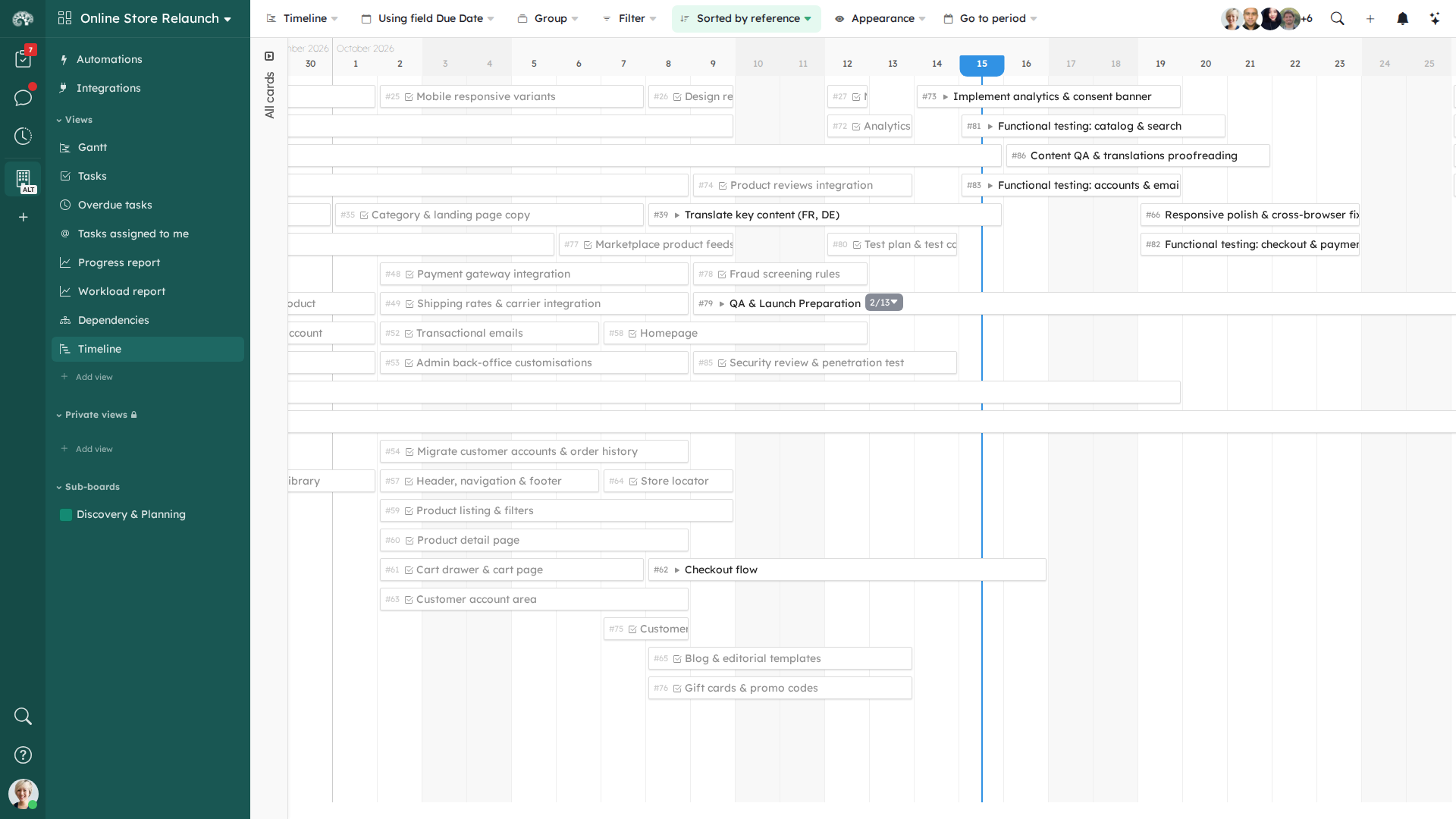
Basics
- Using field …: choose the date field to show. The timeline can also show a lookup of a date, or a formula that returns a date, for example
as_daterange({created at};{Due Date:end}). A card without an end date shows “start date - ?”. - Group and Filter: like in the other views, the cards are in groups, one row for each group.
- The sidebar on the left lists the cards of each group, even the cards without dates. Fold it to see the cards only on the timeline: Kantree then uses as few lines as possible. This compact display shows how many cards of a group are planned at the same time.
- Today: the blue line.
To change the dates of a card:
- drag its bar to move it,
- drag one end of the bar to change its start or its end date,
- to give dates to a card that has none, drag on its row in the timeline.
Click a card to open it. Right-click it to open its menu.
Sub-cards
Click the number of sub-cards on a card to show or hide its sub-cards. When the sub-cards go beyond the dates of their parent, a bar shows the whole period of the sub-cards. In the compact display, Kantree uses this whole period.
Good to know
- You cannot reorder the cards of a group by drag and drop.
- The bars use the color of the card type of the cards.
- Sub-cards are ordered by reference.
- Cards that do not have the selected date field are hidden, but the number at the top of the group counts them.
- iCalendar feed, in the Appearance menu, gives you a link to see the cards in your calendar app.
Gantt view
General information
The Gantt view shows a project plan: the tasks on their dates, and the dependencies between them. When a task moves, Kantree can move the tasks that depend on it.
- Each workspace has one Gantt configuration, shared by all its Gantt views.
- The dependencies are a relationship field: a task lists the tasks that it depends on.
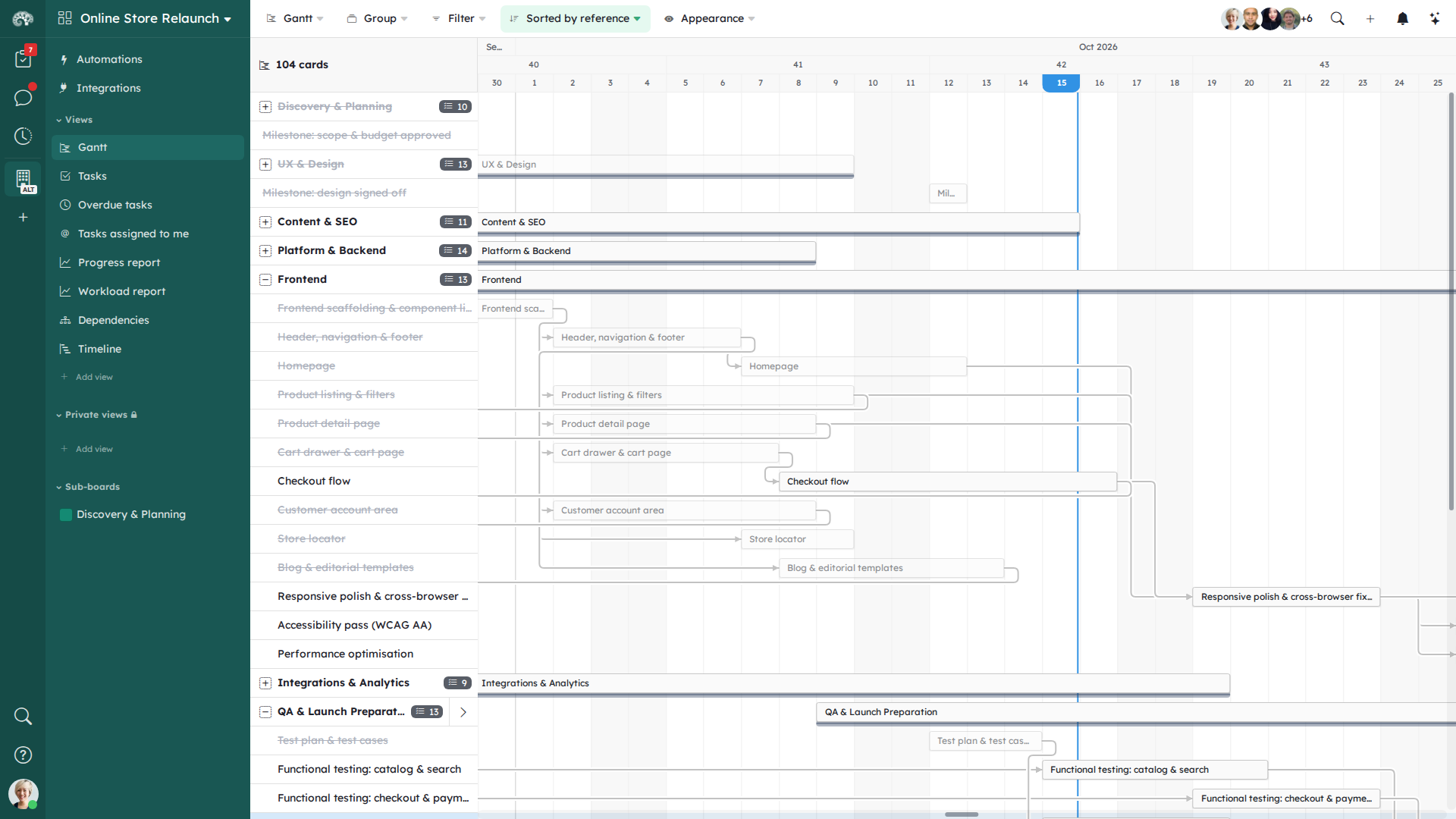
Availability
On kantree.io, the Gantt view is available with the Business plan. On private cloud and self-hosted installations, it is available by default.
Configure the Gantt view
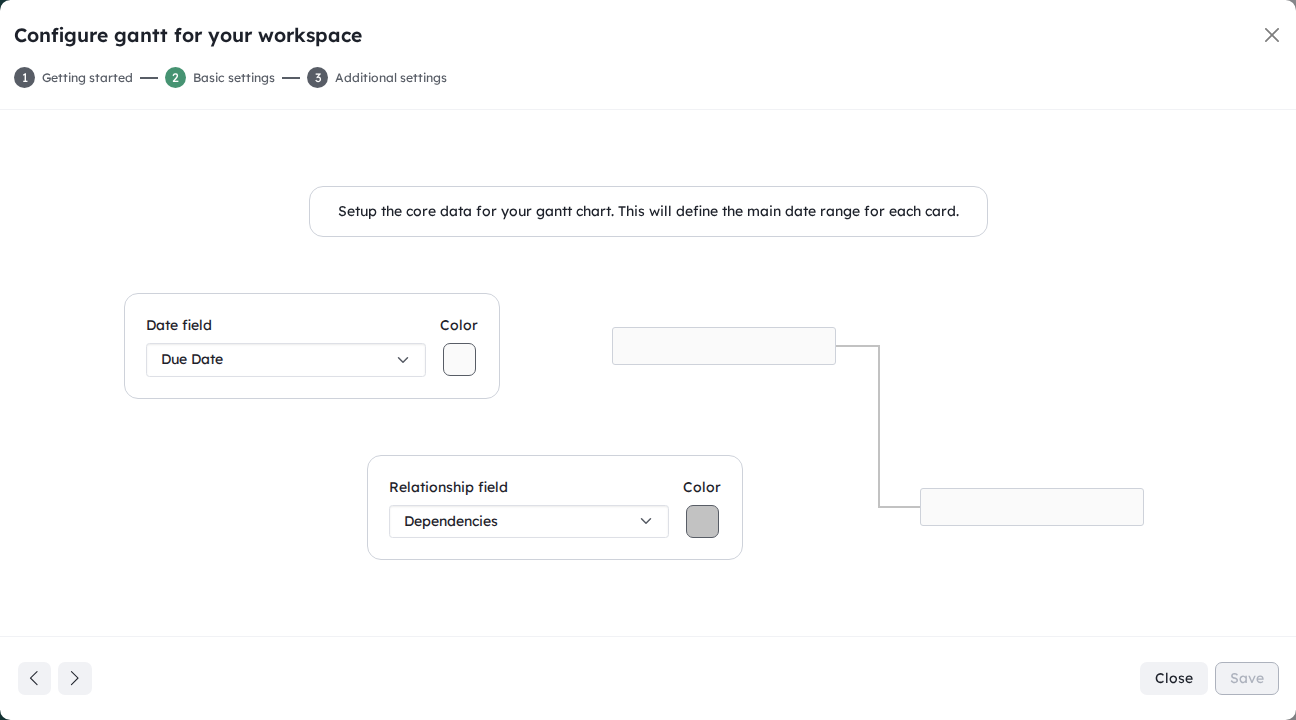
Open the Appearance menu, then click Configure Gantt. The assistant has three steps:
- Getting started: an introduction.
- Basic settings:
- Date field: the dates of the tasks, and the color of their bars.
- Relationship field: the dependencies, and the color of their lines.
If these fields do not exist yet, create them from the assistant.
- Additional settings:
- Project schedule: an optional Deadline, to compare it with the forecast end of the project. The schedule starts at the earliest date of the tasks.
- Work calendar: the Working days of your team. Kantree counts delays and lags in working days.
- Secondary date fields: other dates to show on the same row, as periods or as milestones. See below.
Dependencies
Create a dependency
- In the Gantt view: drag the end point of a bar to another bar. The dependency is “finish to start”: the second task starts when the first one ends.
- Or in a card: add the tasks that the card depends on to its relationship field.
When you create a dependency from task A to task B, Kantree saves it in task B: B depends on A.
Change or delete a dependency
Right-click the line of the dependency:
- Lag / lead (working days): a positive number adds a delay between the two tasks (lag), a negative number makes them overlap (lead).
- Delete: removes the dependency.
Move the tasks that depend on a task
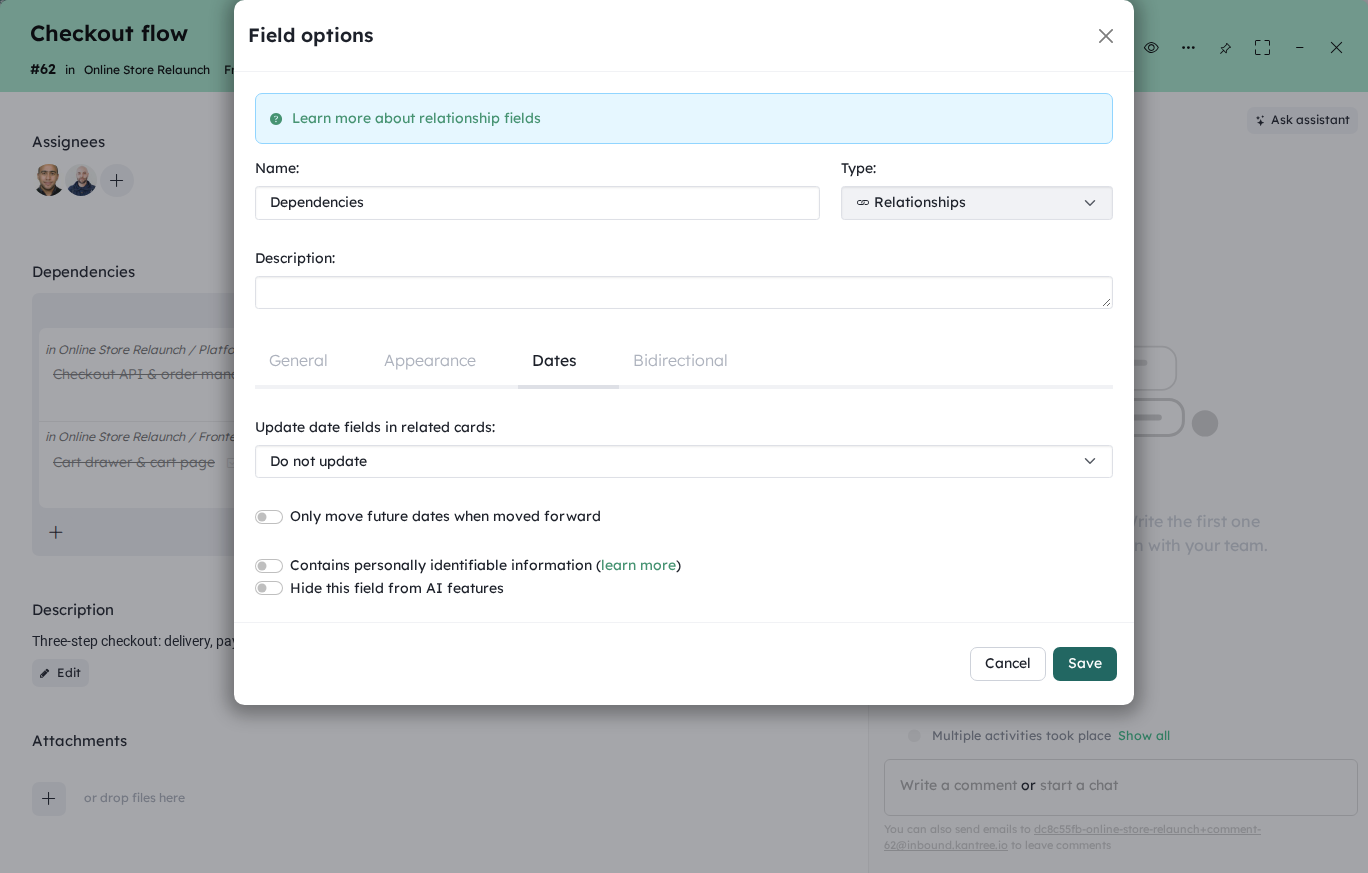
To move the dependent tasks when the dates of a task change, open the options of the relationship field, then the Dates tab:
- Update date fields in related cards: choose Referencing this card through this field.
- Only move future dates when moved forward: optional.
Several dates on the same row
The Gantt view can show other date fields next to the main dates, for example a planned date and an actual date. In Configure Gantt, step Additional settings, add a secondary date field, then choose how to show it: as a Date range or as a Milestone. You can create the date field from there.
Dependencies only apply to the main dates.
Milestones
Milestones are important dates, shown as diamonds. To show them, add a secondary date field in Configure Gantt, and choose Milestone. The date can be shared by several cards, or belong to a card that represents the milestone.
Display options
In the Appearance menu of a Gantt view:
- Visible period: the dates shown on the screen.
- Display non-working days: show or hide the weekends and the other non-working days.
- Display card titles: Inside the period writes the title of the cards in their bars.
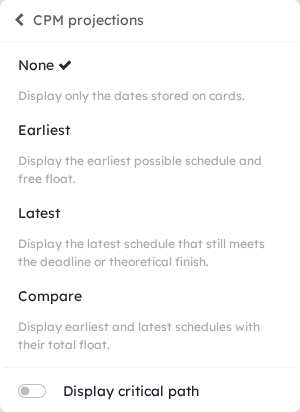
- CPM projections: the critical path method computes the schedule from the dependencies.
- None: shows the dates saved in the cards.
- Earliest: the earliest possible schedule, and the free float (how long a task can be late without delaying the next task).
- Latest: the latest schedule that still meets the deadline.
- Compare: both schedules, and the total float (how long a task can be late without delaying the project).
- Display critical path: shows in red the tasks that decide the end date of the project. If one of them is late, the project is late.
- Prevent period overlaps: on a row, the bars never overlap.
- iCalendar feed: a link to see the tasks in your calendar app.
If a card has a Percentage field, its value appears as a progress bar in the bar of the card.
Keyboard and mouse
- Space + drag, or Shift + mouse wheel: move the chart horizontally.
- Ctrl + mouse wheel: zoom in or out.
Dependencies view
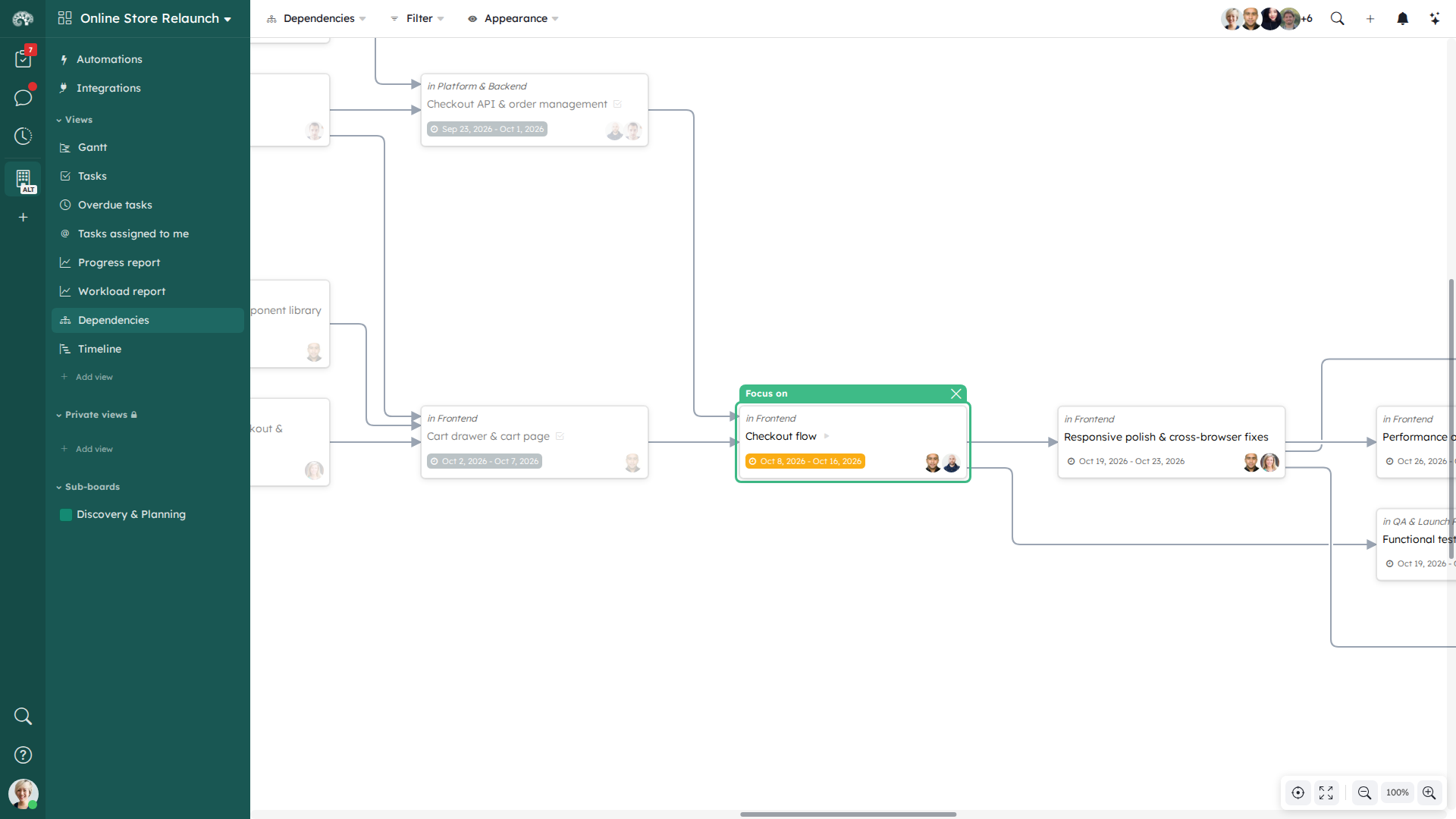
The Dependencies view shows the cards as a network: each line is a dependency. Use it to understand the order of the work, and to find the tasks that block the others.
In the Appearance menu:
- Relationship field: the field that holds the dependencies.
- Matching branches only: shows only the branches that contain cards that match the filter.
- Focused branches only: shows only the branches of the selected card.
- Display critical path: shows the tasks that decide the end date of the project.
To focus on a card, open it, then click the dependencies button at the top of the card (Focus card in Dependencies view). Use the buttons at the bottom right to center the view, fit it to the screen, and zoom.
On kantree.io, the Dependencies view is available with the Business plan.